

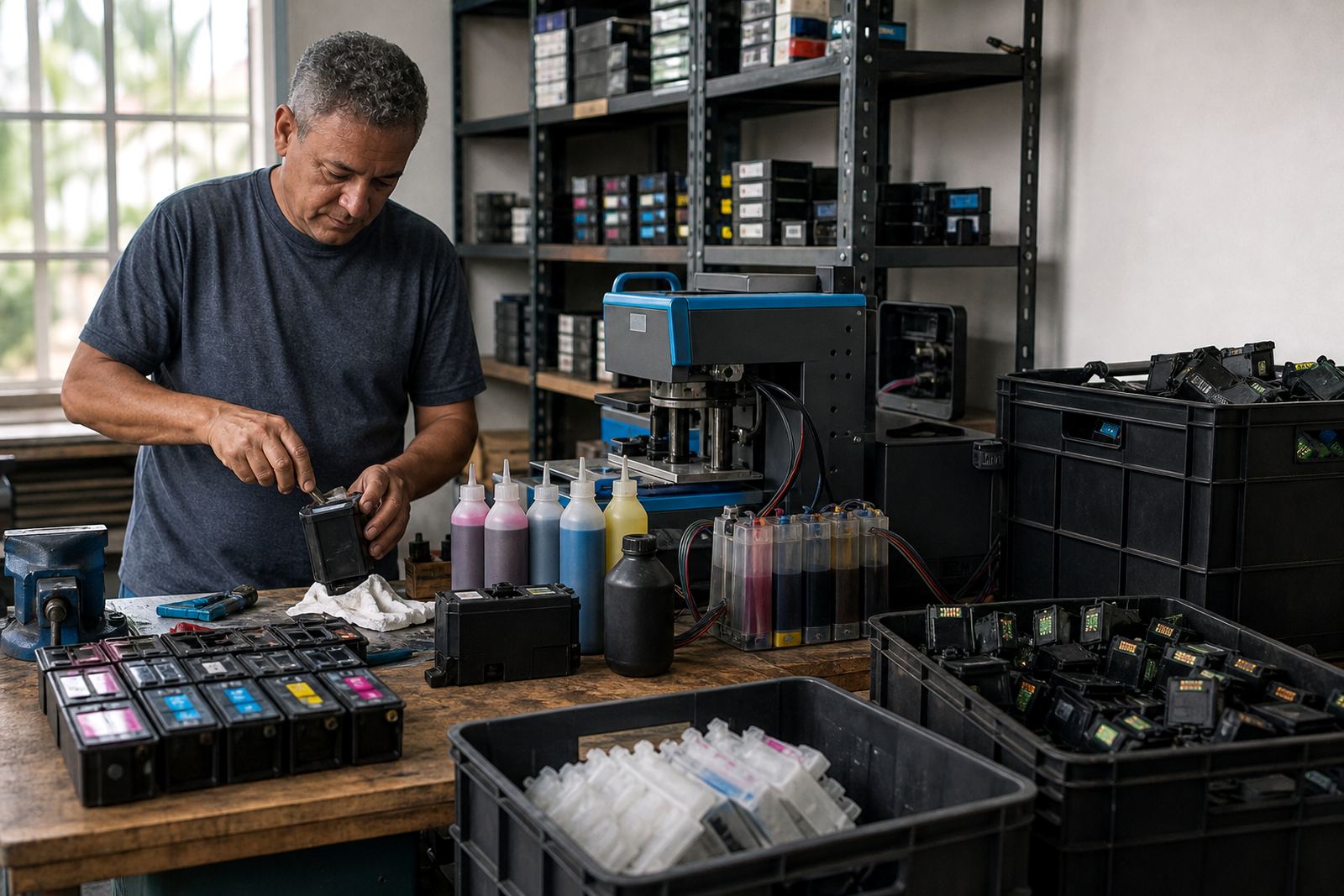
A Westville workbench and a better way to print
The first jobs were handled from a small Westville base, with cartridges arriving from offices, home studios and print rooms that needed a cheaper path than replacing every unit. The early focus was hands-on: inspect the shell, clean the parts that matter, refill where suitable and test the output before anything left the bench. That routine shaped the way the business still works today.
Refurbished cartridges became part of the answer because many users only needed steady everyday printing, not a fresh cartridge for every run. The team learned quickly that good work sits in the details, especially with clogged nozzles, mixed ink types and cartridges that had been handled badly before they arrived. A quiet habit formed around careful checks, plain advice and no fuss at the counter.
When offices, artists and print rooms needed different things
As the customer base widened, the jobs did too. A legal office in Durban might want clear black text and reliable page counts, while a studio in Cape Town could need accurate colour for layouts, proofs and artwork. Wide-format print shops brought another set of needs, with longer runs, more ink movement and a sharper eye on colour balance, nozzle health and waste.
That mix taught the team not to speak about ink in one broad way. Dye ink, pigment ink, refill kits and continuous ink supply systems all behave differently, and each one has its own strengths. Pigment ink is often preferred where sharper text and better water resistance matter, while dye ink can suit colour work where bright output and smooth blending are part of the task.
- Office users often want dependable black text and tidy running costs.
- Design teams usually ask for colour consistency and clean line work.
- Wide-format operators need careful ink matching and steady feed control.
- Some users only need guidance on whether a refill or a replacement makes sense.
The craft behind a refill that actually behaves
Refill work looks simple from the outside, but a proper job needs judgement. The team checks for dried ink, damaged seals, worn chips and air leaks before any refill is done. On many cartridges, the chip is part of the conversation too, because the printer has to recognise the cartridge properly for the job to keep moving. Chip reset help is handled in general terms, with care taken not to force a cartridge that is already past useful service.
Printhead care sits close to that work. A nozzle check can reveal blocked channels, weak lines or colour shifts long before a full page fails. Small issues are usually easier to sort early, and the same applies to cleaning habits, storage and the type of ink chosen for the printer. Some clients only need a straight refill, while others need a longer look at colour balance and feeding problems, especially after a cartridge has stood unused for a while.
How the team runs the counter, bench and dispatch
The business is now carried by a working team, each person with a practical role that keeps the day moving. Sibusiso Kotze leads the business, Ayesha Majola keeps operations in order, Mandla Zondi handles refill work, Lauren Naidoo manages customer support, Johan Mabena coordinates courier movement and Nokuthula Mabuza looks after accounts and orders. That structure matters because refill work, dispatch and customer guidance often overlap in the same hour.
Jobs are not treated as one-size-fits-all. A set of cartridges for an office in Johannesburg may need a different packing approach from a refill kit going to Pretoria or a wide-format supply headed for Pietermaritzburg. The team also helps with stock planning, so regular users can think ahead about empty cartridges, spare bottles and the type of ink that suits their printer and workload.
- Cartridge refill advice for day-to-day office use.
- CISS setup help for printers that suit continuous supply systems.
- Leak checking and empty return handling where cartridges are collected back.
- Remote troubleshooting for users who need plain guidance before opening a unit.
What customers still ask for, and what the answers usually touch on
The same practical questions still arise, even as more customers are added. People want to know whether a cartridge can be refilled safely, which ink type suits their printer, and how to avoid mess when handling a refill kit. Others ask about recycling empties, because waste matters when a business prints every day and does not want a stack of plastic and spent cartridges building up in the office.
Bulk ink systems add another layer. They can cut waste and reduce the number of cartridge swaps, but they also need proper setup, steady ink levels and a printer that suits the system. The team gives guidance on nozzle checks, colour balance and the practical side of printhead care, because these small habits often decide whether the printer behaves or turns into a headache mid-job.
Courier work widened the reach well beyond Durban. Customers in Ballito, Hillcrest, Cape Town and other parts of South Africa can use the same kind of support, with the conversation focused on the machine, the ink and the task in front of them rather than on sales talk. That is how the business has kept its footing: by staying close to the work and honest about what each printer can take.
The shape of the business today
Today InkEx is still grounded in the same practical trade that shaped the early days, only with a broader group of customers and a stronger bench of skills. The base in Westville supports offices, artists, studios and wide-format print shops with refurbished cartridges, refill systems and advice that makes sense in a South African workplace. Some clients need a once-off refill. Others rely on stock planning, empty returns and help with the odd problem that shows up after heavy use.
What holds the work together is not jargon, but repeatable habits: inspect first, match the ink properly, test the output and treat each printer as its own case. That is still the best way to handle the mix of machines, paper types and printing habits that arrive every week. The result is a business shaped by use, not by noise, and built around keeping printing practical for the people who rely on it.